
Read our latest private credit commentary from Shannon Fritz, Deputy Chief Investment Officer.
Key Points
01
Perpetual BDC redemptions have grabbed the headlines but allocations to private credit in the larger institutional market continue to rise.
02
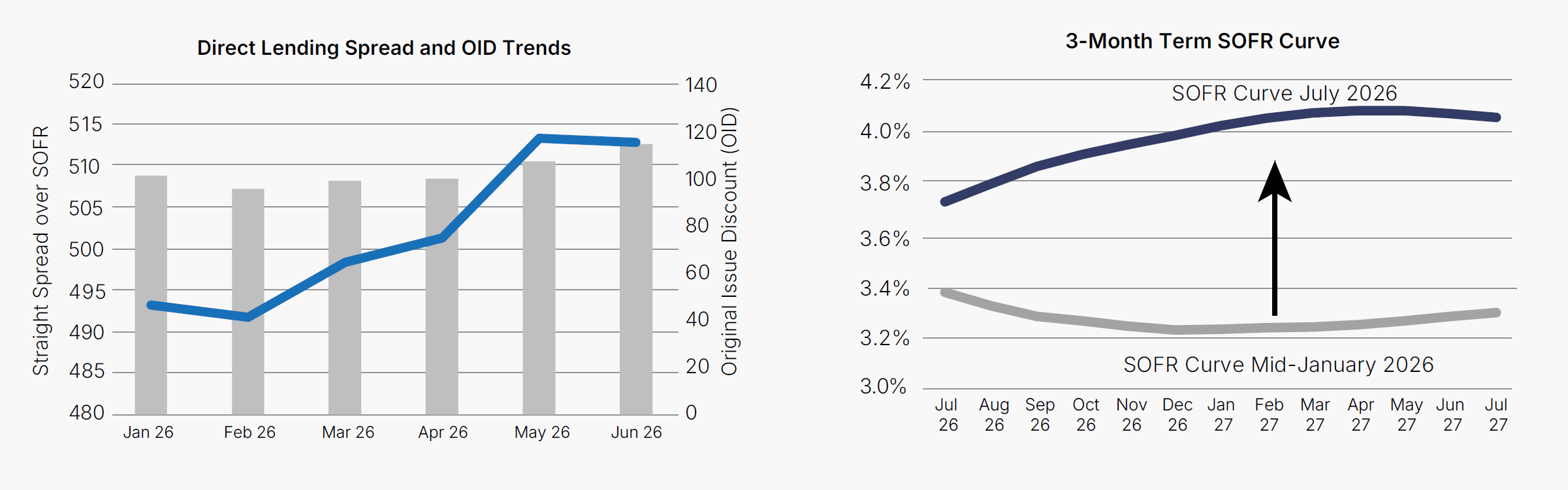
Recent direct loan spread widening has improved the economics of capital deployment. A more hawkish Fed may also lift base rates/yields with the SOFR curve now rising through 1Q27.
03
AI disruption concerns and elevated non-accrual dispersion among lenders underscore the importance of manager selection, underwriting discipline, and portfolio construction.
Bottom Line
The recent wave of BDC redemption activity and AI disruption concerns does not suggest that the long-term investment case for private credit has been undermined. In fact, private credit deployment prospects appear to be improving and institutional allocations continue to rise. However, manager quality matters more than it has in some time, with differentiation likely to be driven by disciplined underwriting, selective origination, strong work-out capabilities, and extensive experience managing through credit cycles.
Performance Remained Positive Despite Headwinds in 1Q26; Deployment Economics Improving
After outperforming leveraged loans, high-yield bonds, and aggregate bond indices in 2025, the Cliffwater Direct Lending Index (CDLI) returned 1.1% in 1Q26. While below the 2%+ pace of recent quarters, the moderation was driven primarily by unrealized valuation marks, particularly among certain software credits affected by AI-related concerns and broader spread widening. Income generation remained stable, contributing approximately 2.3% of quarterly return, while realized losses remained limited.¹
Importantly, spread widening presents both challenges and opportunities. While wider spreads can reduce the marked value of existing loans, they also improve the economics of new investments. Direct lending spreads for quality borrowers have widened by approximately 25–50 basis points in recent months, and OIDs have widened (see Exhibit 1), representing a meaningful improvement in lender economics and prospective returns.
The capital deployment environment is improving more broadly as well. Documentation has strengthened, financial covenants are returning in select transactions, and collateral protections have tightened.
Exhibit 1: Spreads and SOFR Base Rates Move Higher1
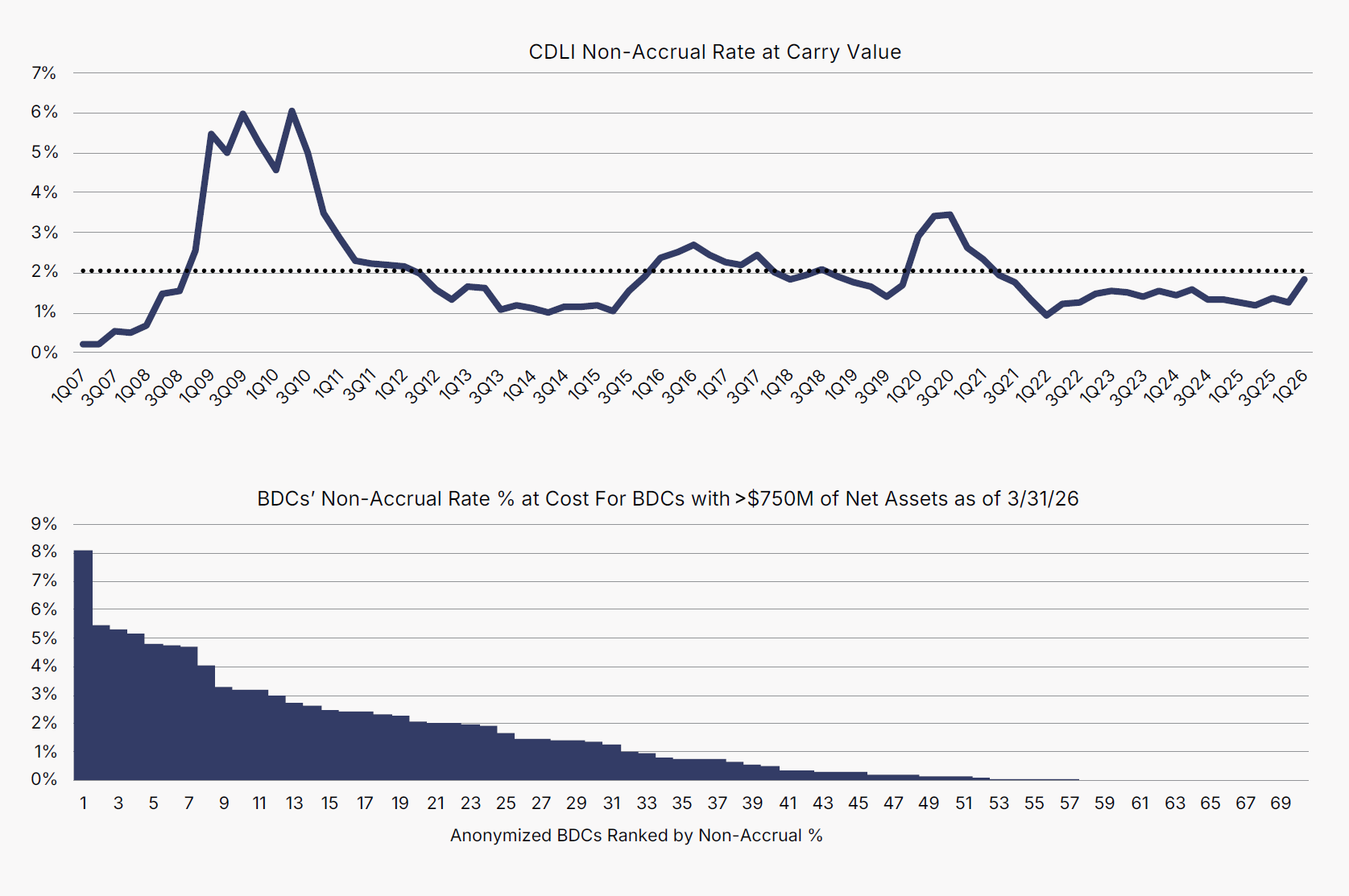
Although defaults in direct lending may move moderately higher in the coming quarters as forecast by KBRA DLD2, the average BDC non-accrual rate remains broadly in line with its long-term average3 and historical experience suggests that unrealized losses will only partially translate into realized losses.4 Meanwhile, underlying borrower fundamentals have generally proven resilient. Revenue growth has moderated, but many borrowers have shifted their focus toward profitability management, contributing to improving coverage ratios and stronger credit profiles.
As we have seen repeatedly across prior cycles, periods of market caution often create some of the most attractive lending vintages. The combination of wider spreads, stronger structures, and disciplined deployment conditions is increasingly constructive for lenders positioned to capitalize on the opportunity.
Exhibit 2: 1Q26 Averaged Non-Accrual Rate Trend and Dispersion2
“Democratization” Growing Pains, But Limited Liquidity Risk; Institutional Allocations Rising
Perpetual BDC redemptions remain the focus of negative headlines. Recent reporting indicates that investors requested approximately $15.6 billion of withdrawals during 2Q26, up from approximately $13.9 billion in 1Q26, reflecting continued pressure in portions of the wealth channel.5
Those figures are noteworthy, but we believe they should be viewed in context. First, the redemption caps embedded in perpetual BDC structures are functioning largely as designed. The quarterly 5% redemption limit is not a bug—it is a purposefully designed feature that helps balance the interests of redeeming and remaining investors while recognizing the inherently illiquid nature of the underlying assets. While redemption requests have increased, most large funds continue to operate within the framework investors agreed to when they invested.
Second, available liquidity sources—including bank facilities, liquid broadly syndicated loan holdings, portfolio repayments, and credit secondary markets—appear sufficient to manage elevated redemption activity. Rating agencies have similarly concluded that current liquidity and asset coverage cushions should support issuers’ ability to manage increased tender activity without material pressure on credit profiles.6
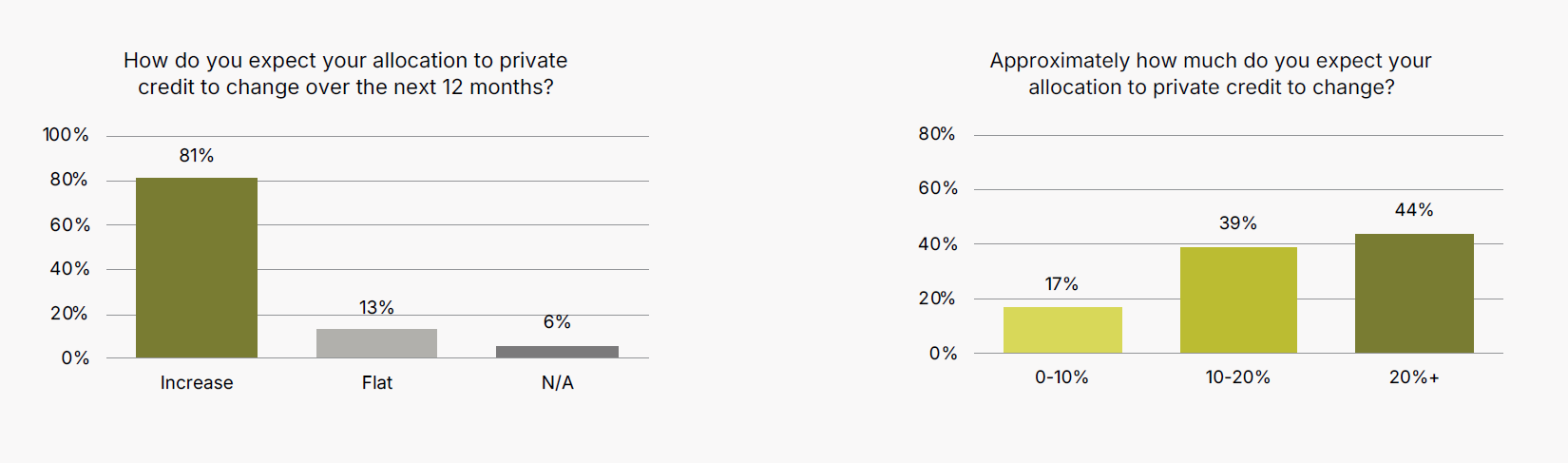
Perhaps more importantly, the wealth channel tells only part of the story. Institutional demand remains robust. According to PwC’s 2026 Global Private Credit Survey, more than 80% of portfolio managers expect to increase allocations to private credit over the next year. While respondents anticipate somewhat higher defaults and credit losses than recent years, they also emphasized the growing importance of investment selection, governance, downside protection, and manager quality.7
The recent redemption cycle therefore appears less like a referendum on private credit itself and more like a reminder that vehicle structure and manager quality matter. While perpetual, non-listed BDC fundraising conditions may remain challenging in the near term, we continue to believe the probability of a broader liquidity or systemic-risk event remains low.
Exhibit 3: Non-Listed BDC Net Flows ($B)3
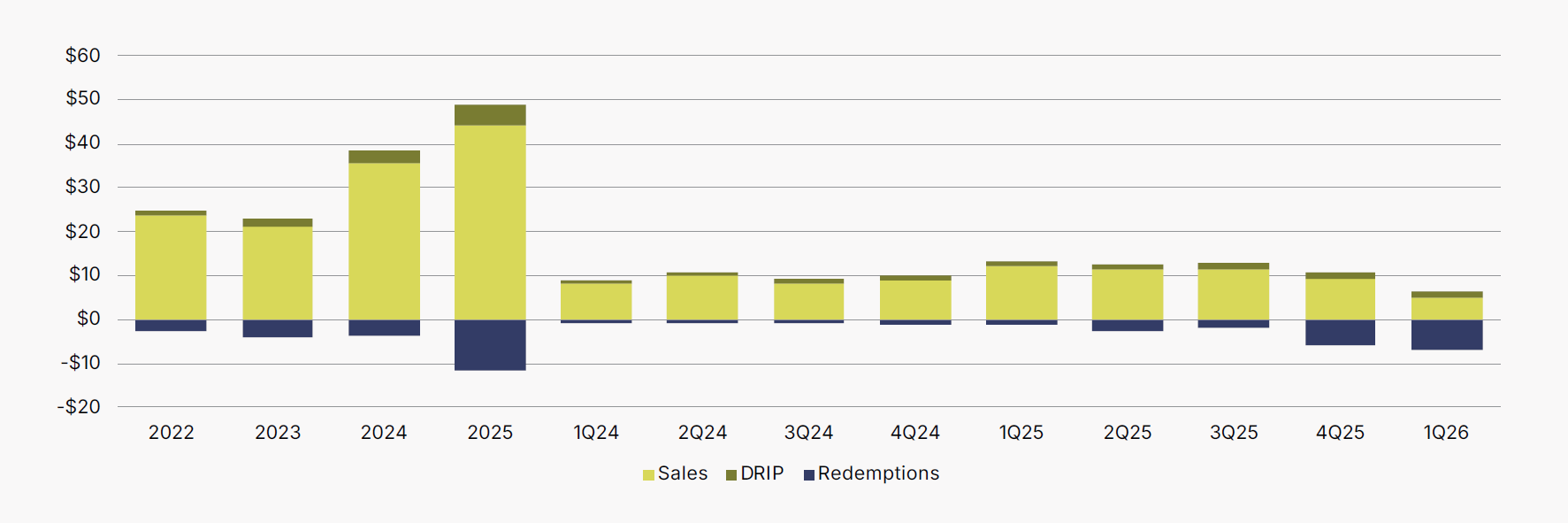
Exhibit 4: Institutional Private Credit Allocation Outlook - PwC Global Private Credit Survey4
AI, Software Credit, and the Importance of Selectivity
No topic has generated more investor discussion over the past year than artificial intelligence and its potential impact on software credits.
Assessing AI-related disruption requires a nuanced approach. Not all software companies face the same risks, and the key question is how technological change may affect individual borrowers and business models. As a result, software underwriting increasingly focuses on several critical considerations:
- How susceptible is the product to displacement by AI-native competitors?
- Have barriers to entry meaningfully declined?
- Does the company possess proprietary data, regulatory advantages, or workflow integration that create durable competitive moats?
- How deep are customer switching costs?
- Is the company positioned to leverage AI to strengthen its business, or must it fundamentally adapt its model to remain competitive?
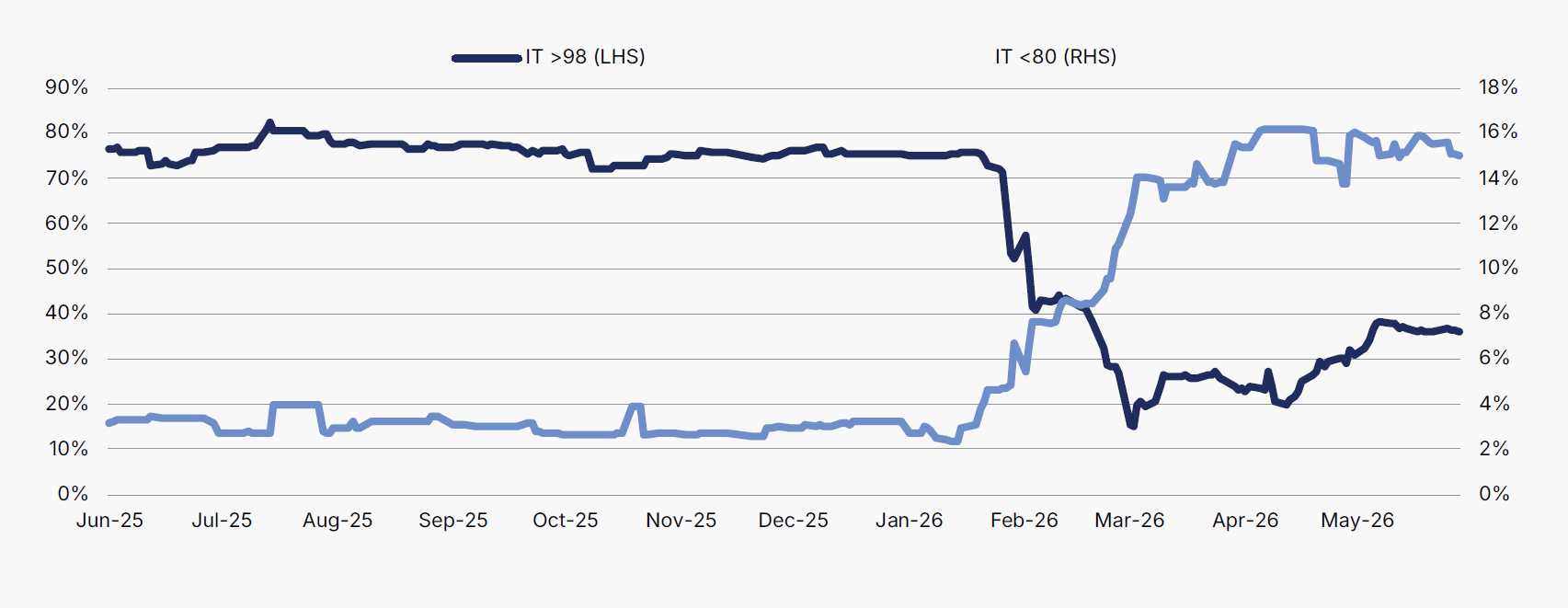
These distinctions are increasingly reflected in software loan price performance. Mission-critical platforms embedded within complex workflows—particularly in regulated or vertically specialized markets—generally face different risk profiles than narrowly focused applications with limited differentiation.
As a result, many lenders have become more selective toward software exposure. However, for investors with deep sector expertise, rigorous underwriting frameworks, and a clear understanding of competitive positioning, the current environment may create opportunities to differentiate between durable businesses and those more vulnerable to disruption.
Exhibit 5: Information Technology Companies Seeing Loan Price Bifurcation5
An Era of Differentiation
As Antares celebrates its 30th anniversary, it is instructive to reflect on what has changed and what endures. The firm’s experience spans multiple market cycles, including the dot-com downturn, the Global Financial Crisis, COVID-19, supply-chain disruptions, geopolitical volatility, and the rapid rise in interest rates. While each cycle has presented unique challenges, the core principles of successful credit investing have remained remarkably consistent: understanding how risks affect individual borrowers, maintaining disciplined underwriting standards, constructing diversified portfolios, and actively managing credits as conditions evolve.
Today, private credit continues to benefit from a constructive long-term outlook. Capital deployment conditions are improving, non-accrual rates remain relatively low, interest coverage has been generally strengthened, and institutional demand for the asset class remains robust. At the same time, AI-related disruption, geopolitical uncertainty, inflation, and elevated energy prices remain important sources of risk that require careful underwriting and portfolio management.
Against this backdrop, we believe private credit is entering a period where manager quality matters more than it has in some time. Outcomes are becoming increasingly differentiated across managers, vintages, and sectors, with performance driven less by broad market tailwinds and more by underwriting discipline, portfolio construction, sector expertise, and the depth of resources supporting credit selection and management.
While results will inevitably vary across lenders, we believe private credit remains well positioned to deliver resilient performance in the years ahead. In an increasingly differentiated market, managers with disciplined underwriting, selective origination, strong restructuring capabilities, and extensive experience navigating credit cycles should be best positioned to capitalize on the opportunities ahead.
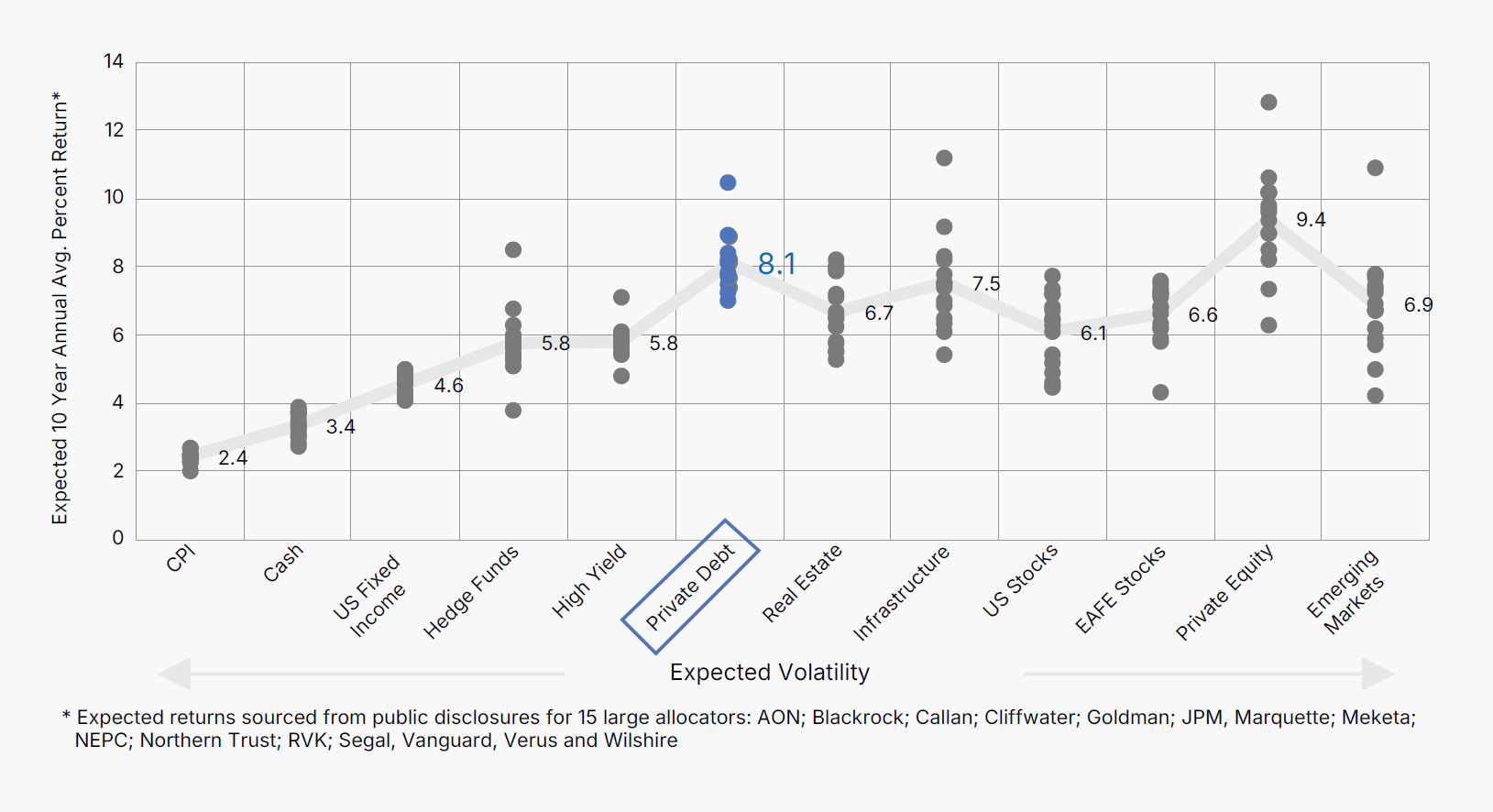
Exhibit 6: Top Allocator Expected Return by Asset Class6
Text sources:
1. Cliffwater Direct Lending Index
2. KBRA DLD US Direct Lending Default Research, May 26, 2026
3. LSEG LPC BDC Collateral 1Q26
4. Cliffwater Direct Lending Index 1st Quarter, 2026 Webinar: https://www.youtube.com/watch?v=WmeRIv6VuSw
5. Wall Street Journal “Investors In Private Funds Seek To Pull $16 Billion” article, July 3, 2026
6. Fitch Ratings, June 1, 2026: https://www.fitchratings.com/research/corporate-finance/perpetually-non-traded-bdcs-positioned-to-withstand-near-term-redemptions-01-06-2026
7. PwC, Global Private Credit Survey 2026; Private credit’s next phase – growth under pressure: https://www.pwc.com/gx/en/industries/private-equity/private-credit-survey.html
Exhibit sources:
1. KBRA DLD North American Insights & Outlook June 2026 for spreads; Chatham Financial for SOFR Curves
2. CDLI for historical average non-accrual rate; LSEG LPC BDC Collateral for 1Q26 BDC non-accrual ranking
3. The Stanger Market Pulse April 2026
4. PwC Private Credit Survey May 26, 2026
5. S&P, UBS
6. Cliffwater 2Q26 Asset Allocation Webinar
Disclosures
Reflects Antares’ beliefs unless otherwise cited with a source. The materials presented herein are provided to you solely for informational purposes and unless otherwise indicated herein, has been prepared using, and is based on, information obtained by Antares Capital (“Antares”) from publicly available sources. Information provided herein is subject to change depending on market conditions. It does not constitute an agreement, or an offer, commitment to offer, or agreement to sell any loans, securities or other assets including interests in any fund or vehicle. The materials contained herein are not intended, nor should they be construed or implied, to be a recommendation or advice of any kind. The information set forth herein has been compiled as of the date(s) noted, is preliminary and subject to change. There is no obligation on the part of Antares to update the information provided herein after the date hereof. Neither Antares nor any affiliate thereof represents or warrants the accuracy, completeness or reliability of any of the materials contained herein, either expressly or impliedly, for any particular purpose, and shall have no duty to update or correct any such information. Without in any way limiting the generality of the foregoing, you understand that certain of the information provided herein is based on information provided by third parties, and neither Antares nor any affiliate thereof makes any representation or warranty regarding the accuracy, completeness or reliability of any such information. In no event will Antares be liable for any losses or damages arising from or as a result of the use of the information or the materials contained herein.
Certain information contained herein concerning economic trends and performance is based on or derived from information provided by independent third-party sources. Antares believes that such information is accurate and that the sources from which it has been obtained are reliable; however, none of Antares nor any of its affiliates or agents can guarantee the accuracy of such information and they have not independently verified and are not responsible for any inaccuracies, omissions and outdated information contained in such third-party information or the assumptions on which such information is based. Certain other information regarding market analysis and conclusions could be based on opinions or assumptions (including those of Antares) that Antares considers reasonable. Unless otherwise indicated, such market analysis and conclusions represent the subjective views or beliefs of Antares.
The materials presented herein may include certain projections, forecasts and estimates that are forward-looking statements. Any such forward-looking statements are based on certain assumptions about future events and are subject to various risks and uncertainties. Forward-looking statements are necessarily speculative in nature and it should be expected that some or all of the assumptions underlying them will not materialize or will vary significantly from actual results. Accordingly, actual results will vary from the projections, and such variations may be material. Some important factors that could cause actual results to differ materially from those in any forward-looking statements contained in these materials include, without limitation, changes in interest rates, default and recovery rates, market, financial or legal uncertainties, the timing of acquisitions of loans, the types of loans acquired, differences in the actual allocation of loans from those assumed mismatches between the time of accrual and receipt of interest proceeds from the loans and whether or not and how loan investments may be leveraged.
Any statements involving matters of opinion or estimates, whether or not so expressly stated, are set forth as such and not as representations of fact, and no representation is made that such opinions or estimates will be realized. The statements and expressions of opinion contained in this presentation are subject to change without notice and involve known and unknown risks, uncertainties and other factors, and undue reliance should not be placed thereon nor should they form the basis of an investment decision.
For Benefit Plan Investors
Not in limitation of the foregoing, if you are (or are acting on behalf of) a person that is a “benefit plan investor”, as defined in Section 3(42) of ERISA and DOL regulations (“Benefit Plan Investor”) you are not authorized to, and should not, rely on any information Antares is providing to you as a basis for, or otherwise in connection with, making a decision whether or not to invest with Antares. Antares has not provided and will not provide any investment advice of any kind whatsoever (whether impartial or otherwise) and Antares is not acting as a fiduciary, within the meaning of Section 3(21) of ERISA, and regulations thereunder, to the Benefit Plan Investor or to any fiduciary or other person making investment decisions on behalf of the Benefit Plan Investor, in connection with these materials or any related presentation.
Additional Matters and Important Information for All Non-U.S. Investors
An interest in products or services referenced in this presentation may not be licensed in all jurisdictions, and unless otherwise indicated, no regulator or government authority has reviewed this document or the merits of the products and services referenced herein. If you receive a copy of this presentation, you may not treat this as constituting a public or other offering and you should note that there may be restrictions or limitations to whom these materials may be made available. This presentation is directed at and intended for institutional investors (as such term is defined in the various jurisdictions). This presentation is provided on a confidential basis for informational purposes only and may not be reproduced in any form. Before acting on any information in this presentation, recipients should inform themselves of and observe all applicable laws and regulations of any relevant jurisdictions. Recipients should inform themselves as to the legal requirements and tax consequences within the countries of their citizenship, residence, domicile and place of business with respect to the ongoing provision of services, and any foreign exchange restrictions that may be relevant thereto. Antares does not accept any responsibility, nor can be held liable for any person’s use of or reliance on the information and opinions contained herein. Any entity responsible for forwarding this material to other parties takes responsibility for ensuring compliance with applicable securities laws.
Notice to persons in the European economic area and the United Kingdom
This presentation is being made available: (1) to persons in the European economic area only if they are professional investors as defined in the Alternative Investment Fund Managers Directive (2001/61/EU); and (2) to persons in the United Kingdom only if they are professional investors, as defined in the Alternative Fund Managers Regulations 2013 and fall within the following categories of exempt persons under the Financial Services and Market Act (Financial Promotion) Order 2005 (the “FPO”) and the Financial Services and Markets Act 2000 (Promotion of Collective Investment Schemes) (Exemptions) Order 2001 (the “CISPO”): (i) persons who are investment professionals, as defined in article 19(5) of the FPO and article 12(5)of the CISPO; (ii) persons who are high net worth companies, unincorporated associations etc., as defined in article 49(2)(a) to (d) of the FPO and article 22(2)(a) to (d) of the CISPO; or (iii) persons to whom it may otherwise lawfully be communicated. This presentation is provided for informational purposes only and does not constitute as offer to purchase, acquire, or subscribe for any type of investment.